Author Nicholas Covaleski
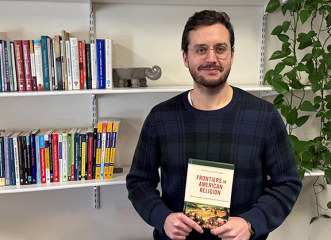 Nicholas Covaleski, Assistant Director of the Center for the Enhancement of Learning and Teaching, published Frontiers in American Religion: Myth, Technology, and the Making of a Pioneering People.
In this interview, Nick discusses the book’s central arguments, what led him to the topic, and how frontier mythology continues to shape science, technology, and American culture.
Give us a brief synopsis of what your book is about.
This book explores how religious ideas helped shape the way Americans imagined, developed, and used new technologies throughout the twentieth century. It shows how a powerful and popular myth – that crossing new frontiers leads to a society’s spiritual renewal – influenced everything from space travel and eugenics to psychedelics and computers. By highlighting the religious roots and themes of frontier mythology, the book reveals how beliefs tied to the nation’s settler-colonial past continue to inform its high-tech present.
What led you to choose this topic to be the focus of your doctoral scholarship?
While my training is in religious studies, I’m not especially interested in any one religious tradition. Rather, I’m more interested in applying theories and methods from religious studies to areas that seemingly have little to do with religion – areas like science and technology – in an effort to capture religion’s operations in places far flung from churches and holy texts. As I like to say, with the right set of lenses, religion’s fingerprints can be found almost anywhere.
This book is an extension of those broader interests. I noticed that language about exploring and conquering “new frontiers” is ubiquitous in the worlds of science and technology, and I already had a general awareness of frontier mythology and the religious content baked into it. So I asked: how has this religious/mythological worldview influenced the worlds of science and technology in the modern U.S.? And with that, I had a project!
What did this work teach you that you didn’t yet know, and has this informed changes to your worldview in any way?
Tough question! One major takeaway from this project was how strongly it underscored Mark Twain’s idea that “history doesn’t repeat itself, but it often rhymes.” The book is organized around case studies that examine individuals, movements, and institutions influenced by frontier mythology across roughly a century (from the late nineteenth to the late twentieth century). While there were important differences between cases, I was most struck by the similarities – by the recurring patterns of belief, action, and consequence that the frontier myth inspired across very different contexts. In that sense, the book’s historical account may offer useful insight into what to expect the next time we hear calls to explore and conquer new frontiers.
What was the most exciting aspect of writing this book?
On the research side, I had the opportunity to work in some really cool archives, including collections at NASA Headquarters, Caltech, and Stanford – all of which contain amazing artifacts. On the writing side, it was exciting to see the different threads gradually come together into a coherent whole. But the most exciting aspect was submitting the final manuscript.
Why should someone outside of the disciplines of religion, philosophy, and ethics read your book?
The book is actually pretty light on religion, philosophy, and ethics (as far as academic texts go, at least). At its core, the book is about how science and technology have been interwoven into the making of American culture, politics, and identity. It draws on religious studies and philosophy to make better sense of how that dynamic has unfolded in our recent past, as well as in our present and near future. Readers will find no shortage of parallels between the book’s historical narrative and contemporary events.
How does it feel to hold this book after so many years of hard work?
Like a feeling that is definitely worth pursuing again!
What’s a question about your new book that I should have asked and didn’t?
I’ve touched on this a bit already, but one important question concerns the book’s relevance to our current moment. One of the central ideas of frontier mythology is that territorial expansion is the key to regenerating not only the state’s power but also the spirit of the American people. We see versions of this idea being tapped, often implicitly, by contemporary political leaders to motivate and justify aggressive action abroad. This book helps us understand that expansionist policies and agendas aren’t only about economics and energy, or politics and power. They’re about all of those things, of course, but they’re also often about something deeper, less tangible, and perhaps even more potent – something like religion.